

Matcha Buzz
What is Matcha?
Matcha is a green tea typically grown in Japan. It is gradually covered to block sunlight, resulting in increased chlorophyll that is responsible for its bright green color. Matcha is then picked, processed, and ground using granite into a fine powder. Matcha is so concentrated it’s said to be the equivalent to 10 cups of green tea.

What is Matcha?
Matcha is a green tea typically grown in Japan. It is gradually covered to block sunlight, resulting in increased chlorophyll that is responsible for its bright green color. Matcha is then picked, processed, and ground using granite into a fine powder. Matcha is so concentrated it’s said to be the equivalent to 10 cups of green tea.
Nutritional Info:

One cup of matcha is the nutritional equivalent of drinking 10 cups of green tea with over 100 times the antioxidants. Matcha is full of antioxidants including EGCg. EGCg catechins counteract the effects of free radicals from pollution, UV rays, radiation, and chemicals, which can lead to cell and DNA damage. Matcha is rich in L-Theanine, an amino acid that promotes a state of relaxation and well-being by creating alpha waves in the brain, which lead to a state of relaxed alertness. And while L-Theanine is common in all tea, matcha may contain up to five times more of this amino acid than common black and green teas. Matcha is also high in vitamin C, selenium, chromium, zinc and magnesium.
Matcha Processes:
Matcha is cultivated mainly in the Uji, Japan. The very best Matcha is harvested once per year in May. Matcha is gradually covered 6 weeks before harvest. The highest grades are grown in almost complete darkness. The covering process, causes an increased production of chlorophyll and amino acids. At this stage the tea is referred to as tencha. Matcha is made by removing the stems and veins from tencha and stonegrinding the rest of the leaf to make a powder.
There are different grades of matcha. Ceremonial grade is the highest quality, used in tea ceremonies. Premium grade is suitable for daily consumption. Matcha for cooking is the cheapest kind. It can be added to desserts and baked goods.

Brewing Processes:
A chawan is a special bowl around 5 inches (12.7cm) in diameter, and 3.5 inches (8.9cm) tall. The inside of the bowl usually has rounded edges that swoop down. Although only a small amount of liquid will be brewed, you will need extra room for whisking.If you do not have an actual chawan, a cereal bowl or small mixing bowl will work as a good substitute.
It is very important to sift your matcha before brewing it. It will prevent clumps from forming. There is a sifter made specifically for matcha, but a small, fine mesh strainer works equally well. (So well in fact, I don’t even have an actual Furui to take a picture of.)
The chasen is one of the most important utensils you will need for making matcha. Although, an immersion blender can make a great substitute. A chasen made for matcha, will have around 100 tines (bristles). Made of bamboo, these tines are soft and pliable when wet.
The matcha it self does not dissolve, rather is suspended in the water. Whisking helps to create a unique rich taste, an initial vegetal, astringent taste, followed by a lingering sweetness. The intensity of the experience compares to one’s first taste of dark chocolate or red wine.
A chashaku is used for scooping and measuring the amount of matcha you are about to use. Made of a thin piece of bamboo, the chashaku is usually around 7 inches (17.8cm) long. Often, in the middle of the length will be a nub from the section of bamboo stalk that the scoop was made from.
Any type of measuring spoon will work as an alternative, but the chashaku is fun to use!

Pu'erh Tea
The Origins of Pu’erh
Today, Pu’erh is a staple and revered tea all over the world, but the creation of this highly sought after tea was a sort of fluke. Pu’erh’s accidental existence emerged during the Tang Dynasty (618-907 A.D.).
The Origins of Pu’erh
Today, Pu’erh is a staple and revered tea all over the world, but the creation of this highly sought after tea was a sort of fluke. Pu’erh’s accidental existence emerged during the Tang Dynasty (618-907 A.D.). China’s tea market was proudly thriving, and subsequently tea merchants were struggling to transport tea over long treacherous journeys, some that stretched as long as a month! In an attempt to relieve some of their struggles, tea merchants began packaging teas in a brick form. This made the tea more compact and would improve overall production efficiency. Off the teas would go, making their perilous journey to Yunnan, where they would be transported all over the world. Unexpectedly, the tightly compounded tea would begin to ferment during the trip! The fermentation process would change the tea’s color from green to dark and the flavor would become richer and more complex. The merchants had accidently created a new tea that would rival Oolong and Jasmine tea. They named this tea after the town of Pu’erh, which is located in central Yunnan.

Realizing their wonderful mistake, Chinese tea experts began perfecting the art of creating Pu’erh. Overtime, tea experts discovered that Pu’erh’s earthy flavor was acquired due to slow oxidation and the assistance of fungal, bacterial, or autooxidation influences. This involvement created a new taste that was profoundly different from other teas such as green, oolong, or black tea. Subsequently, the flavor of Pu’erh can dramatically change over the course of the aging process, without losing it’s earthy yet sweet quality.

Types of Pu’erh
Pu’erh comes in two distinct types: raw or cooked/ripe, also known as Sheng Pu’erh or Shou Pu’erh respectively. Raw pu’erh leaves are withered then heaped into piles to ferment. This process is referred to as “Wo Dui” and is responsible for taste development. The leaves are then pan fried to halt enzyme activity and are left to dry in dry storage with natural humidity to slowly oxidize over time.
Cooked or Ripe pu’erh (Shou Pu’erh) was developed in 1973 by the Kunming Tea Factory in an effort to speed up the fermentation process. The tea leaves are picked and withered then mixed with a bacterial culture designed to mimic the bacteria that would be created during natural fermentation. Then, the pu’erh is left to oxidize for over a month in a hot/humid environment before firing. Cooked pu’erh can be characterized as robust, earthy flavor and aroma, dark, and rich liquor.
Pu’erh Health Benefits
If you’re looking to boost your daily health, look no further. From cancer to weight loss, Pu’erh seems to be the best tea for an overall health enhancement.
For starters, Pu-erh is noted to lower cholesterol. Dr. Andrew Weil mentioned that “A Chinese study performed on rats and published in 2009 showed lowering of LDL (“bad”) cholesterol and triglyceride levels after the animals were fed a pu-erh tea extract, along with an increase in HDL (“good” cholesterol).” Similar to most teas, Pu’erh can also help improve your overall cardiovascular health.
Pu’erh is also rich in antioxidants and antibacterials. This means that Pu’erh will improve your overall health by killing free radicals and harmful bacteria in your body. Drinking a cup of Pu’erh everyday is an easy and tasty way to rid your body of a few toxins.
Pu’erh is also well-known for containing high amounts of caffeine, though most don’t report many side effects until after five cups. Subsequently pu’erh can produce increased alertness and mental clarity.
*We are not doctors at Cup and Kettle. All health information should be retrieved from medical professionals.
Pu’erh Brewing Techniques
Preparing pu’erh is extremely similar to preparing an oolong or black tea, and it’s fairly simple! You can also reuse good quality tea leaves several times after their first brew!

Rooibos Tea
Rooibos Tea Origins
Rooibos tea’s origin takes place in the Cederberg region of South Africa. The Khoisans, indigenous Bushmen of the region, harvested rooibos leaves from the Aspalathus Linearis plant for many centuries, using them as herbal remedies. In Africa, rooibos would become a popular substitute for tea due to its affordability.
Rooibos Tea Origins
Rooibos tea’s origin takes place in the Cederberg region of South Africa. The Khoisans, indigenous Bushmen of the region, harvested rooibos leaves from the Aspalathus Linearis plant for many centuries, using them as herbal remedies. In Africa, rooibos would become a popular substitute for tea due to its affordability. Later in 1772, botanist Carl Humberg first recorded the use of rooibos, subsequently increasing the popularity of rooibos tea worldwide. In 1904, Benjamin Ginsberg began marketing rooibos as “Mountain Tea” as an herbal alternative to tea. In the 1960’s, Annique Theron published a book on rooibos tea’s health benefits. This book inspired hundreds of studies and rooibos popularity exploded!

Rooibos Types
Rooibos, also called redbush tea or bush tea, comes from a plant called Aspalathus linearis.
The most popular type of rooibos is called redbush. This red rooibos is fully fermented and, just as the name hints, contains a beautiful red and brown hue. This rooibos tastes almost nutty, and has a sweet soothing taste.
Green or grey rooibos is another type of rooibos tea. Unlike red rooibos, it is unfermented and therefore does not contain the rich red hue of red rooibos.
Rooibos Health Benefits
Rooibos is well-known for being caffeine free and soothing. After a busy day, rooibos is a wonderful tea to have before bedtime by itself or with a splash of milk.
Rooibos contains antioxidants, similar to other teas! Additionally, rooibos contains small amounts of iron, magnesium, phosphorus, and potassium. Alvaro Viljoen, PhD, of the department of pharmacy at the University of the Witwatersrand, claims that rooibos is rich in vitamin C and low in tannins, unlike most other teas.
Brewing the perfect cup
Amount: 1 teaspoon per 8 ounces of water
Time: 5-10 minutes (longer brewing time increases the antioxidant and nutrient extraction)
Temperature: 212 degrees

Tea Spotlight: White Rose
Today on Tea Spotlight I’ll be talking about our White Rose Tea. This is without a doubt my favorite blended tea. There is just something magical about the light floral brew that brightens my day. I drink a least one cup a day. My favorite time to drink this tea is in the evening after the kids are finally in bed.
Today on Tea Spotlight I’ll be talking about our White Rose Tea. This is without a doubt my favorite blended tea. There is just something magical about the light floral brew that brightens my day. I drink a least one cup a day. My favorite time to drink this tea is in the evening after the kids are finally in bed. Like most working mothers, I still have work to do after the kids are asleep for the night. This tea is great for keeping me alert, but still letting me sleep when I’m ready to call it a night.

So, what’s in this tea to make it so magical?
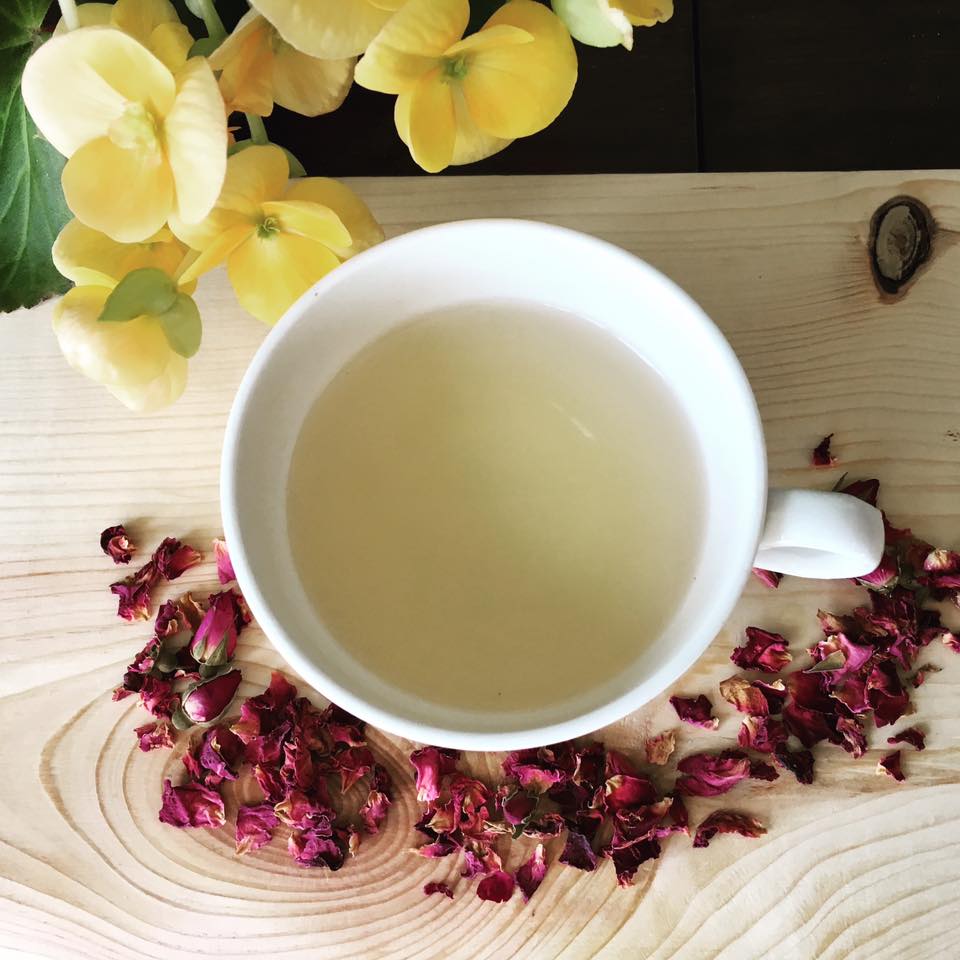
It’s an organic white tea (bai mu dan) made of young tea leaves and silvery unopened leaf buds. This tea hails from Zhenghe town in Fujian Province, the original birthplace of white tea centuries ago. This tea has a sophisticated mouthfeel with a slightly stronger body than Silver Needle. A gentle and slow air-dry withering process results in a brilliant amber infusion with a honey-like viscosity and mild flavor that pairs well with food.
The tea is blended with organic rose petals and organic chrysanthemum blossoms. The rose petals and chrysanthemum adds a sweet and fragrant flavor that is both soothing and offers a delicate taste. Once brewed, it contains a light caffeine boost.
White Rose Tea is perfect whether served hot or iced. To serve hot, steep 1 tablespoon of White Rose tea in a cup of water just below boiling (185 degrees) for 2-3 minutes. Once ready, add a little frothed milk for something smooth and creamy or sip as is. For iced tea, steep 2 tablespoons in just below boiling water and pour over ice.
As an easy alternative to brewing hot, try cold-brewing this tea. Cold-brewing is the easiest way to make never-bitter iced tea with bright flavors. It works for any type of tea. Steep 4 tablespoons in 3 cups of cold water for 8-10 hours in the refrigerator. Remove tea leaves.
Climate Change and Darjeeling Tea
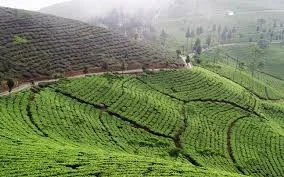
Today I am talking about one of my favorite teas, Darjeeling. Darjeeling hails from the Darjeeling Region of India. Darjeeling is interesting because instead of using the assamica varietal of the tea plant (that hails from India), Darjeeling tea typically comes from a smaller leaf Chinese varietal. It's essentially a Chinese tea that grows in India with flavors of French grapes and Himalayan mountain air. The ‘champagne’ of teas is celebrated for its wine-like profile.
Today I am talking about one of my favorite teas, Darjeeling. Darjeeling hails from the Darjeeling Region of India. Darjeeling is interesting because instead of using the assamica varietal of the tea plant (that hails from India), Darjeeling tea typically comes from a smaller leaf Chinese varietal. It's essentially a Chinese tea that grows in India with flavors of French grapes and Himalayan mountain air. The ‘champagne’ of teas is celebrated for its wine-like profile.
A 20-year study was done by DTR&DC in Kurseong that show the annual temperature in the region has grown by 1 degree Fahrenheit. Rainfall has dropped 30 inches and humidity has dropped by 16 percent. A large part of the formation of Darjeeling’s famous polyflavinols is directly related to cold air trapped below the peaks of the Kanchenjunga Himalayas. With the rising climate comes the risk of losing the iconic Darjeeling flavor profile.

Not only is the flavor at risk, but also production has dropped. During the past decade yields have fallen significantly. In 1994 production exceeded 14 million kilograms, but by 2016 that total had fallen to 8.44 million kilograms. It is important to note that some of the shortfall is due to an extended strike by workers during which most of the second flush crop was lost. Ashok Kumar Lohia, chair of the Chamong Tea Group, which operates 13 Darjeeling estates, told Down To Earth magazine that “erratic weather and delayed rains cost nearly 15 percent loss of production during the first flush.” Increased temperatures have also caused torrential and erratic rainstorms that have been responsible for a marked increase in dangerous landslides.
Tea growers are working hard at coming up with solutions to solve problems created by climate change. Irrigation systems, delayed pruning, and planting tall trees to increase shade are a few solutions being implemented. Perhaps one of the biggest changes is the creation of new drought- and pest-resistant varietals that can withstand the new climate. The hope is that all these efforts will preserve the unique qualities that make tea from Darjeeling so unique.


Women and Tea Innovators
A series highlighting women who have innovated the tea industry

A series highlighting women who have innovated the tea industry
Roberta C. Lawson and Mary Molaren
Inventors of the Tea Bag
In 1901 Roberta Lawson and Mary Molaren designed the “Tea-Leaf Holder.” They had identified an issue with the way tea had been commonly brewed for thousands of years. Having to make a whole pot of tea for the sake of having a single cup meant the rest of the pot was wasted. The easiest solution: just brew the tea in the cup you wanted to drink it from. But they had to make sure the leaves wouldn’t just be floating in the tea, “which would spoil the pleasure of the drink.” Hence their patented mesh bag. The bag folded over the top end of the pocket holding the tea leaves.
Penelope Barker
Edenton Tea Party Organizer
(June 17, 1728 – 1796) was an activist in the American Revolution who in 1774 organized a boycott of British goods known as the Edenton Tea Party
Leader of The Edenton Tea Party a boycott of British goods following the Tea Act - The Boston Tea Party without the violence. “Maybe it has been only men who protested the king up to now. Tat only means we women have taken too long to have let our voices be heard. We are signing our names to a document, not hiding ourselves behind costumes like the way the men in Boston did in their tea party. The British will know who we are.”

Mary Tuke
Queen of Confectionary
One of the very first tea merchants and among the most outstanding across all eras. She built the first chain of stores in the tea and chocolate industry. Tuke faced many struggles in starting her business. For starters, permission to trade in the city of York was only granted if you were a member of the Society of Merchant Adventurers. Being a woman, she was not permitted to join. Lacking a licence to trade, she ran her business anyway. For 7 years Tuke was threatened with fines and jail time. Finally, 8 years after her business was established Mary was ordered to pay a small fine to the society and she was allowed to continue. She is accredited as being the key to making York the global center of the chocolate industry.
Oura Kei
Tea Export Pioneer

A young woman created the Japanese tea export market in the years following Admiral Perry’s forced opening of the the nation. By 30, in a country where women had minimal rights, she built an entire industry. Kei was engaged to the family's adopted son, who was to become the head of the family business. Unfortunately, he passed away at an early age. After this dramatic event, Kei also lost her birth mother and a huge fire destroyed her family's business. Starting over, she saw an opportunity for tea exportation and took action. Kei is responsible for establishing sencha as main crop and built exports from zero to 200 tons in 5 years, 5,000 tons in 10 years.

Tea Tuesdays: Peach Blossom
Today on Tea Tuesday we are highlighting Peach Blossom. Peach blossom is our most popular tea for summer. Peach Blossom was one of my very first tea blends, is my husband’s favorite tea for making sun tea. Peach Blossom iced is all at once calming, cooling, and refreshing. I prefer it hot when I can reminisce about summer on a cold winter day.
Today on Tea Tuesday we are discussing Peach Blossom
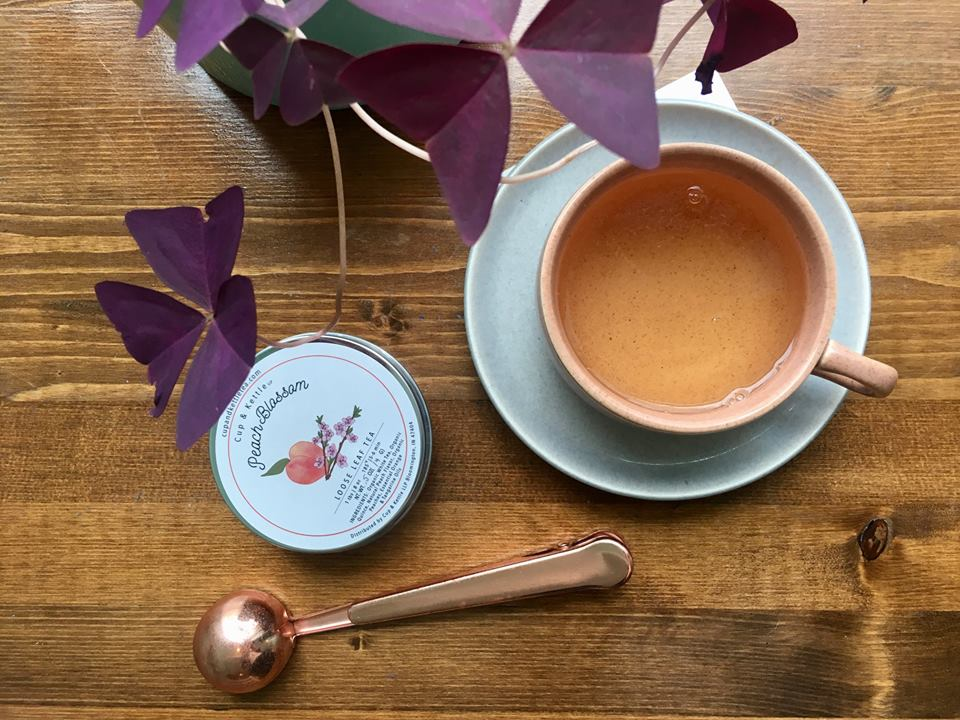

Today on Tea Tuesday we are highlighting Peach Blossom. Peach blossom is our most popular tea for summer. Peach Blossom was one of my very first tea blends, is my husband’s favorite tea for making sun tea. Peach Blossom iced is all at once calming, cooling, and refreshing. I prefer it hot when I can reminisce about summer on a cold winter day.
Peach Blossom tea is blended using our White Peony (Bai Mu Dan) a white tea grown in the Fujian Province of China. Peach Blossom extenuates White Peony’s natural peachy, honey flavor profile. This tea's juicy peach notes are enhanced with hints of quince, vanilla, and zesty tangerine.
To Brew: Use 1-tablespoon tea to 8 ounces of water. Heat water to 185 degrees. Steep for 4 minutes.
For the perfect instant iced tea: Steep 1-tablespoon tea to 4 ounces of water. Heat water to 185 degrees. Steep for 4 minutes. Pour over ice.
For Cold Brew: Use 1-quart glass pitcher, 5 tablespoons of tea leaves, and cold water place in refrigerator over night. The next morning strain out leaves and enjoy!

4 Ways to Overcome Imposter Syndrome
I always hear the term: ‘Fake it until you make it’. And I’m thinking ok, sounds easy I guess, but I’m never sure how faking anything will stop making me feel like an imposter. When I was just out of high school, I fell in love with yoga…

I always hear the term: ‘Fake it until you make it’. And I’m thinking ok, sounds easy I guess, but I’m never sure how faking anything will stop making me feel like an imposter. When I was just out of high school, I fell in love with yoga. Becoming a yoga instructor quickly became my life’s dream. I had such an image of what that would look like. I would be in perfect shape, and a complete expert on everything yoga related. I had built it up so much in my head, it took me 5 years to finally earn my yoga teaching certificate.
When it came time to start practice teaching, I was shaking and actually frozen in fear. My first teaching experience, I was assisting a practiced instructor. There was a woman I was trying to help, I was so nervous I was having a hard time helping her into a pose. Finally, she snapped at me and said: “Will you just tell me what you want me to do?!” I of course quietly responded “Nothing you’re doing great” and walked away. I plastered a fake smile through the duration of the class, then after class went to my car and cried. I felt like a total failure.
I had a choice, I could try and conquer my fear, or quit. I had already moved my family across the country, and spent all our savings on this teacher program, quitting just wasn’t an option. I opted to literally fake my confidence, and you know what it worked! I literally pretended like I was a confident, professional yoga instructor. People believed me and treated me like one. After a while, I believed it too and grew to love teaching.
Here are some helpful tips:
Stand up straight
To appear confident, stand and sit tall. To correct your posture, slightly tuck your chin, raise the crown of your head up higher, and roll your shoulders up and back. When I started doing this, I immediately noticed a change in how people approached me. All of a sudden students and teachers alike began talking to me more, and I felt more welcome. Being approachable and comfortable in social situations is a sign that you are confident with who you are. People really notice.
Mimic Good Leaders
See someone doing what you want to do? Pay attention and learn from them. There was a yoga instructor that I really loved her teaching style. I would observe her classes and really watch how she taught. When I first began teaching, I modeled my voice and classes after her. I eventually went on to create my own teaching style, but she was a major influence in its development.
Surround Yourself with Positive People
This is most important. Spending time with people who believe you can do it, eventually convinces you that you really can. Bonus: spending time with positive people who are already doing what you want to do, makes achieving what you want so natural it feels less like a challenge and more like an inevitability.
What to Avoid
Lying about your qualifications. When I first began teaching, I had been studying and practicing yoga for 5 years and had earned my certification at one of the most renowned schools in the country. I really was qualified, I just lacked confidence in my abilities. Embellishing or lying about your qualifications will eventually get you into trouble. It’s much easier to build trust slowly by being honest when you do not have all the answers, rather than giving wrong answers and losing their trust all together.

Tea News: GABA Tea
One examined the effect of GABA on brain waves and the other put the GABA recipients in stressful situations and monitored their immunoglobulin A levels. Together the studies showed that GABA can have a positive impact on reducing anxiety and encouraging relaxation…

What is GABA?
GABA stands for gamma-aminobutyric acid. It is a neurotransmitter, that naturally occurs in the brain. GABA functions to decrease neuron activity assisting in preventing anxiety and stress.
GABA and tea?
Tea manufacturers have started creating GABA tea. This process began in Japan in the 1980s. Dr. Tsushida Tojiro discovered that anaerobic conditions encourage the conversion of glutamate to GABA. GABA occurs naturally in tea, but typically only contains 6 mg per 100 grams of tea. However, GABA tea contains at least 150 mg of GABA per 100 grams of tea. It is interesting to note that the L-theanine that is also present in tea can impact the brain, encouraging the production of more GABA.
What does the research say about GABA?
GABA has been shown to promote sleep, reduce stress, and anxiety.
GABA as a tool to support better sleep has been well documented by researchers. Data about the work of GABA receptors to help with rest have been used to develop a range of sleep-supporting drugs.
Studies have shown where GABA was introduced to humans to examine how it impacts relaxation. One examined the effect of GABA on brain waves and the other put the GABA recipients in stressful situations and monitored their immunoglobulin A levels. Together the studies showed that GABA can have a positive impact on reducing anxiety and encouraging relaxation.
Does “GABA tea” have these effects?
It is not entirely known how much GABA in tea is able to cross the blood brain barrier. However, GABA blood brain permeability has yet to be studied in humans. It is known that in mice GABA is removed 17 times faster than it entered, resulting in conflicting studies of blood brain permeability. Unfortunately, more research is needed.

Power Trip: Discovering Inner Power
For me it began with a self-admission. It really began 2 years ago. My very first “Goddess Experience”. I had developed this practice of meditating almost daily…

Moment in time where I felt powerless, then looking back saw the inner power that I'd kept hidden.
Wellness Wednesday: What does coming into your own power look like to you?
For me it began with a self-admission. It really began 2 years ago. My very first “Goddess Experience”. I had developed this practice of meditating almost daily. It was during one of these meditations where she appeared to me. She was sitting on a throne surrounded by multitudes of men worshiping her. She looked at me with such power it was awe inspiring. Then, she spoke to me. She told me I was her and that her name (my name) was Venus. To be frank, I did not know much about Venus or any Goddesses, nor had I really thought about them. Immediately, after this experience I spent countless hours studying Venus and Goddesses trying to decode and make sense of this experience.
Finally, 2 years later, it dawned on me that She really is me! This ‘Goddess Experience’ was my unconscious mind speaking to me that I am much more powerful than I know. I’ve spent my life trying to hide my strength from others to avoid being seen as a threat to others to protect myself. I had become a master at hiding my greatness and making myself small and nonthreatening. Growing up, I intentionally hid how smart I was by getting answers wrong on purpose, I intentionally wore the same clothes so people wouldn’t notice me, and let others take credit for my work. I wanted to be invisible because if you can’t see me, you can’t hurt me.
Last week it was as if a lighting bolt went off and I was able to admit to myself that I was really strong and dare I say, powerful. Shortly after that realization, I had a ‘god experience’. This time it came in the form of a dream. I dreamt about this rustic man. We had been together before, and were just starting to reconnect. The only caveat, was that no one could know that we were reconnecting. Especially his mother, where in all the dreams I was constantly hiding our connection from her. The dreams always took place in the same house. The house, I would describe as ornate, had a large courtyard with a two story balcony opening out to the courtyard. In one scene, there was a party and we were standing out in the courtyard. I interacted with everyone and felt welcome, but we were still required to hide our connection. Each dream gradually increased in intensity until the final dream when it met its highest intensity and I multiplied into 50 or so versions of myself (like in the Matrix). In these dreams, it was as if the each dream was building off of itself. What was weird about the dream was it felt like it was controlled by the rustic man. So, naturally, I thought a god must have incepted my dream (because that’s where my logic likes to go)! So, I began frantically researching gods to find out who it was. A couple days pass and I still can’t stop thinking about this dream so I tell a friend who enjoys dream interpreting.
She had some insightful thoughts that really helped me put the dream into perspective. The dream really, was the masculine side of my unconscious showing me my inner power. Not only that, but as the dreams intensified it was as if my unconscious mind was inserting my inner power into my consciousness.
Ok let's talk about what happened to me in a more scientific way. The human body vibrates to its own rhythm. This brain emits its own unique set of brain waves: Beta, Alpha, Theta, Delta, and Gamma. Each wave operates at its own frequency. Each frequency represents a unique state of consciousness.
Beta (12-30Hz): Beta waves are associated with waking, alert consciousness. Beta waves a critical to effectively function in everyday life but is also responsible for activating stress responses and anxiety. Beta waves are that nagging internal voice that often can be our biggest critic. The higher your beta frequency, the more persistent and nagging the voice can be. Your mind is literally turnt up.
Alpha (7.5-12Hz): Alpha waves become present during deep relaxation. It can be felt in light meditation or day-dreaming. Alpha waves are helpful visualization, memory, learning, and concentration. It’s thought to bridge the gap between the conscious and subconscious mind.
Theta (4-7.5Hz): Theta brain waves are found during deep meditation and light sleep, the REM dream state as well. At this state you can experience vivid visualizations, great inspirations, and insights. At theta frequency the ‘voice’ of the mind is silent.
Delta (.5-4Hz): Delta waves are the slowest and is presented in deep, dreamless sleep or deep meditation. Delta is the unconscious mind. This frequency is responsible for regeneration and healing.
Gamma (30-100Hz): Gamma waves are faster than Beta waves and are associated with high-level information processing.
I believe what I experienced during my ‘Goddess experience’ and ‘God experience’ was a result of me accessing my theta wave frequencies. I was able to access my first experience through deep meditation and second through my REM dream cycle. Both had profound impacts on my own self discovery. What happens now that I’ve discovered my inner power?
To be continued….