

Latest Muses
Eventually, I realized these pieces belonged together. So I gathered them, gave them space, and turned them into a book of their own.


5 Things I've Learned About Running A Business

The number of women owned businesses has increased almost 3,000 percent since 1972. Running a business is challenging and ever changing. From emotional ups and downs to It can be empowering and humbling all at once. Here are some things I’ve learned and have been learning throughout my journey as an entrepreneur.
Your prices reflect the knowledge you have, not your personal worth.
Even now, I struggle with prices. Your pricing is not a reflection of your personal worth, but of the processes and efficiencies you create. It can be challenging to be confident in what to charge. It is important as a business owner to understand how overhead, variable and fixed costs, and experience are reflected in pricing. My best advice is to take yourself out of the equation. If you consider your business a separate entity, how much is the product really worth? It becomes less personal and more about creating a sustainable business that fosters community support.
Get help, no person is an island
Know your strengths and weaknesses. No one can do everything. Hire out the things you struggle with the most. Even in the beginning, before you are making money it’s important to start building your team. Start by hiring a lawyer, insurance agent, banker, and broker. These people are key to growing your community. In most cases, their success is dependent on yours. When I first started my business I researched and interviewed all of these people. If the meeting felt transactional and not team oriented, I moved on until I found the right fit. As your business grows little things begin to fall through the cracks and burn-out becomes a real problem. Look at the areas where you are struggling to maintain quality and hire someone who is better suited. This frees you up to grow your business and prevents burn-out.
“The dream is real, but the hustle is sold separately.”
There is never a perfect time to do anything. The time is now. Nothing is perfect, your product will evolve naturally as you go. ‘Every journey begins with a single step’, yes? Maybe it’s not possible to dive all in at once, but there are always little steps you can take to work towards your goals. What can you do right now, to bring you a little closer? Statistically speaking, people who actively engage in achieving their goals are more successful than those who wait for the opportunity to present itself.
Challenge your perception of fear.
True growth comes from facing fears. I loved the book Big Magic by Elizabeth Gilbert. “Fear is always, because creativity asks you to enter into realms of uncertain outcome. This is nothing to be ashamed of. It is, however, something to be dealt with.” Fear of failure can be a paralyzing force. Being vulnerable is hard and requires a level of self-acceptance and self-love that can be difficult to build within ourselves. Start by accepting your fear, and doing it anyway.
Know your audience
Put yourself in your customers shoes. Interact with your community. How can you connect your product with what drives them? The reason we start businesses is to create community. Fostering community is a two way street. It’s a give and take: you offer a solved problem, is the solved problem beneficial to your community?

Matcha Buzz
What is Matcha?
Matcha is a green tea typically grown in Japan. It is gradually covered to block sunlight, resulting in increased chlorophyll that is responsible for its bright green color. Matcha is then picked, processed, and ground using granite into a fine powder. Matcha is so concentrated it’s said to be the equivalent to 10 cups of green tea.

What is Matcha?
Matcha is a green tea typically grown in Japan. It is gradually covered to block sunlight, resulting in increased chlorophyll that is responsible for its bright green color. Matcha is then picked, processed, and ground using granite into a fine powder. Matcha is so concentrated it’s said to be the equivalent to 10 cups of green tea.
Nutritional Info:

One cup of matcha is the nutritional equivalent of drinking 10 cups of green tea with over 100 times the antioxidants. Matcha is full of antioxidants including EGCg. EGCg catechins counteract the effects of free radicals from pollution, UV rays, radiation, and chemicals, which can lead to cell and DNA damage. Matcha is rich in L-Theanine, an amino acid that promotes a state of relaxation and well-being by creating alpha waves in the brain, which lead to a state of relaxed alertness. And while L-Theanine is common in all tea, matcha may contain up to five times more of this amino acid than common black and green teas. Matcha is also high in vitamin C, selenium, chromium, zinc and magnesium.
Matcha Processes:
Matcha is cultivated mainly in the Uji, Japan. The very best Matcha is harvested once per year in May. Matcha is gradually covered 6 weeks before harvest. The highest grades are grown in almost complete darkness. The covering process, causes an increased production of chlorophyll and amino acids. At this stage the tea is referred to as tencha. Matcha is made by removing the stems and veins from tencha and stonegrinding the rest of the leaf to make a powder.
There are different grades of matcha. Ceremonial grade is the highest quality, used in tea ceremonies. Premium grade is suitable for daily consumption. Matcha for cooking is the cheapest kind. It can be added to desserts and baked goods.

Brewing Processes:
A chawan is a special bowl around 5 inches (12.7cm) in diameter, and 3.5 inches (8.9cm) tall. The inside of the bowl usually has rounded edges that swoop down. Although only a small amount of liquid will be brewed, you will need extra room for whisking.If you do not have an actual chawan, a cereal bowl or small mixing bowl will work as a good substitute.
It is very important to sift your matcha before brewing it. It will prevent clumps from forming. There is a sifter made specifically for matcha, but a small, fine mesh strainer works equally well. (So well in fact, I don’t even have an actual Furui to take a picture of.)
The chasen is one of the most important utensils you will need for making matcha. Although, an immersion blender can make a great substitute. A chasen made for matcha, will have around 100 tines (bristles). Made of bamboo, these tines are soft and pliable when wet.
The matcha it self does not dissolve, rather is suspended in the water. Whisking helps to create a unique rich taste, an initial vegetal, astringent taste, followed by a lingering sweetness. The intensity of the experience compares to one’s first taste of dark chocolate or red wine.
A chashaku is used for scooping and measuring the amount of matcha you are about to use. Made of a thin piece of bamboo, the chashaku is usually around 7 inches (17.8cm) long. Often, in the middle of the length will be a nub from the section of bamboo stalk that the scoop was made from.
Any type of measuring spoon will work as an alternative, but the chashaku is fun to use!

Pu'erh Tea
The Origins of Pu’erh
Today, Pu’erh is a staple and revered tea all over the world, but the creation of this highly sought after tea was a sort of fluke. Pu’erh’s accidental existence emerged during the Tang Dynasty (618-907 A.D.).
The Origins of Pu’erh
Today, Pu’erh is a staple and revered tea all over the world, but the creation of this highly sought after tea was a sort of fluke. Pu’erh’s accidental existence emerged during the Tang Dynasty (618-907 A.D.). China’s tea market was proudly thriving, and subsequently tea merchants were struggling to transport tea over long treacherous journeys, some that stretched as long as a month! In an attempt to relieve some of their struggles, tea merchants began packaging teas in a brick form. This made the tea more compact and would improve overall production efficiency. Off the teas would go, making their perilous journey to Yunnan, where they would be transported all over the world. Unexpectedly, the tightly compounded tea would begin to ferment during the trip! The fermentation process would change the tea’s color from green to dark and the flavor would become richer and more complex. The merchants had accidently created a new tea that would rival Oolong and Jasmine tea. They named this tea after the town of Pu’erh, which is located in central Yunnan.

Realizing their wonderful mistake, Chinese tea experts began perfecting the art of creating Pu’erh. Overtime, tea experts discovered that Pu’erh’s earthy flavor was acquired due to slow oxidation and the assistance of fungal, bacterial, or autooxidation influences. This involvement created a new taste that was profoundly different from other teas such as green, oolong, or black tea. Subsequently, the flavor of Pu’erh can dramatically change over the course of the aging process, without losing it’s earthy yet sweet quality.

Types of Pu’erh
Pu’erh comes in two distinct types: raw or cooked/ripe, also known as Sheng Pu’erh or Shou Pu’erh respectively. Raw pu’erh leaves are withered then heaped into piles to ferment. This process is referred to as “Wo Dui” and is responsible for taste development. The leaves are then pan fried to halt enzyme activity and are left to dry in dry storage with natural humidity to slowly oxidize over time.
Cooked or Ripe pu’erh (Shou Pu’erh) was developed in 1973 by the Kunming Tea Factory in an effort to speed up the fermentation process. The tea leaves are picked and withered then mixed with a bacterial culture designed to mimic the bacteria that would be created during natural fermentation. Then, the pu’erh is left to oxidize for over a month in a hot/humid environment before firing. Cooked pu’erh can be characterized as robust, earthy flavor and aroma, dark, and rich liquor.
Pu’erh Health Benefits
If you’re looking to boost your daily health, look no further. From cancer to weight loss, Pu’erh seems to be the best tea for an overall health enhancement.
For starters, Pu-erh is noted to lower cholesterol. Dr. Andrew Weil mentioned that “A Chinese study performed on rats and published in 2009 showed lowering of LDL (“bad”) cholesterol and triglyceride levels after the animals were fed a pu-erh tea extract, along with an increase in HDL (“good” cholesterol).” Similar to most teas, Pu’erh can also help improve your overall cardiovascular health.
Pu’erh is also rich in antioxidants and antibacterials. This means that Pu’erh will improve your overall health by killing free radicals and harmful bacteria in your body. Drinking a cup of Pu’erh everyday is an easy and tasty way to rid your body of a few toxins.
Pu’erh is also well-known for containing high amounts of caffeine, though most don’t report many side effects until after five cups. Subsequently pu’erh can produce increased alertness and mental clarity.
*We are not doctors at Cup and Kettle. All health information should be retrieved from medical professionals.
Pu’erh Brewing Techniques
Preparing pu’erh is extremely similar to preparing an oolong or black tea, and it’s fairly simple! You can also reuse good quality tea leaves several times after their first brew!

Rooibos Tea
Rooibos Tea Origins
Rooibos tea’s origin takes place in the Cederberg region of South Africa. The Khoisans, indigenous Bushmen of the region, harvested rooibos leaves from the Aspalathus Linearis plant for many centuries, using them as herbal remedies. In Africa, rooibos would become a popular substitute for tea due to its affordability.
Rooibos Tea Origins
Rooibos tea’s origin takes place in the Cederberg region of South Africa. The Khoisans, indigenous Bushmen of the region, harvested rooibos leaves from the Aspalathus Linearis plant for many centuries, using them as herbal remedies. In Africa, rooibos would become a popular substitute for tea due to its affordability. Later in 1772, botanist Carl Humberg first recorded the use of rooibos, subsequently increasing the popularity of rooibos tea worldwide. In 1904, Benjamin Ginsberg began marketing rooibos as “Mountain Tea” as an herbal alternative to tea. In the 1960’s, Annique Theron published a book on rooibos tea’s health benefits. This book inspired hundreds of studies and rooibos popularity exploded!

Rooibos Types
Rooibos, also called redbush tea or bush tea, comes from a plant called Aspalathus linearis.
The most popular type of rooibos is called redbush. This red rooibos is fully fermented and, just as the name hints, contains a beautiful red and brown hue. This rooibos tastes almost nutty, and has a sweet soothing taste.
Green or grey rooibos is another type of rooibos tea. Unlike red rooibos, it is unfermented and therefore does not contain the rich red hue of red rooibos.
Rooibos Health Benefits
Rooibos is well-known for being caffeine free and soothing. After a busy day, rooibos is a wonderful tea to have before bedtime by itself or with a splash of milk.
Rooibos contains antioxidants, similar to other teas! Additionally, rooibos contains small amounts of iron, magnesium, phosphorus, and potassium. Alvaro Viljoen, PhD, of the department of pharmacy at the University of the Witwatersrand, claims that rooibos is rich in vitamin C and low in tannins, unlike most other teas.
Brewing the perfect cup
Amount: 1 teaspoon per 8 ounces of water
Time: 5-10 minutes (longer brewing time increases the antioxidant and nutrient extraction)
Temperature: 212 degrees

Tea Spotlight: White Rose
Today on Tea Spotlight I’ll be talking about our White Rose Tea. This is without a doubt my favorite blended tea. There is just something magical about the light floral brew that brightens my day. I drink a least one cup a day. My favorite time to drink this tea is in the evening after the kids are finally in bed.
Today on Tea Spotlight I’ll be talking about our White Rose Tea. This is without a doubt my favorite blended tea. There is just something magical about the light floral brew that brightens my day. I drink a least one cup a day. My favorite time to drink this tea is in the evening after the kids are finally in bed. Like most working mothers, I still have work to do after the kids are asleep for the night. This tea is great for keeping me alert, but still letting me sleep when I’m ready to call it a night.


So, what’s in this tea to make it so magical?
It’s an organic white tea (bai mu dan) made of young tea leaves and silvery unopened leaf buds. This tea hails from Zhenghe town in Fujian Province, the original birthplace of white tea centuries ago. This tea has a sophisticated mouthfeel with a slightly stronger body than Silver Needle. A gentle and slow air-dry withering process results in a brilliant amber infusion with a honey-like viscosity and mild flavor that pairs well with food.
The tea is blended with organic rose petals and organic chrysanthemum blossoms. The rose petals and chrysanthemum adds a sweet and fragrant flavor that is both soothing and offers a delicate taste. Once brewed, it contains a light caffeine boost.
White Rose Tea is perfect whether served hot or iced. To serve hot, steep 1 tablespoon of White Rose tea in a cup of water just below boiling (185 degrees) for 2-3 minutes. Once ready, add a little frothed milk for something smooth and creamy or sip as is. For iced tea, steep 2 tablespoons in just below boiling water and pour over ice.
As an easy alternative to brewing hot, try cold-brewing this tea. Cold-brewing is the easiest way to make never-bitter iced tea with bright flavors. It works for any type of tea. Steep 4 tablespoons in 3 cups of cold water for 8-10 hours in the refrigerator. Remove tea leaves.

Climate Change and Darjeeling Tea
Today I am talking about one of my favorite teas, Darjeeling. Darjeeling hails from the Darjeeling Region of India. Darjeeling is interesting because instead of using the assamica varietal of the tea plant (that hails from India), Darjeeling tea typically comes from a smaller leaf Chinese varietal. It's essentially a Chinese tea that grows in India with flavors of French grapes and Himalayan mountain air. The ‘champagne’ of teas is celebrated for its wine-like profile.
Today I am talking about one of my favorite teas, Darjeeling. Darjeeling hails from the Darjeeling Region of India. Darjeeling is interesting because instead of using the assamica varietal of the tea plant (that hails from India), Darjeeling tea typically comes from a smaller leaf Chinese varietal. It's essentially a Chinese tea that grows in India with flavors of French grapes and Himalayan mountain air. The ‘champagne’ of teas is celebrated for its wine-like profile.
A 20-year study was done by DTR&DC in Kurseong that show the annual temperature in the region has grown by 1 degree Fahrenheit. Rainfall has dropped 30 inches and humidity has dropped by 16 percent. A large part of the formation of Darjeeling’s famous polyflavinols is directly related to cold air trapped below the peaks of the Kanchenjunga Himalayas. With the rising climate comes the risk of losing the iconic Darjeeling flavor profile.

Not only is the flavor at risk, but also production has dropped. During the past decade yields have fallen significantly. In 1994 production exceeded 14 million kilograms, but by 2016 that total had fallen to 8.44 million kilograms. It is important to note that some of the shortfall is due to an extended strike by workers during which most of the second flush crop was lost. Ashok Kumar Lohia, chair of the Chamong Tea Group, which operates 13 Darjeeling estates, told Down To Earth magazine that “erratic weather and delayed rains cost nearly 15 percent loss of production during the first flush.” Increased temperatures have also caused torrential and erratic rainstorms that have been responsible for a marked increase in dangerous landslides.
Tea growers are working hard at coming up with solutions to solve problems created by climate change. Irrigation systems, delayed pruning, and planting tall trees to increase shade are a few solutions being implemented. Perhaps one of the biggest changes is the creation of new drought- and pest-resistant varietals that can withstand the new climate. The hope is that all these efforts will preserve the unique qualities that make tea from Darjeeling so unique.


Parallel Thoughts from Parallel Worlds
Hi and welcome to Monday Muses with Jessica! This week I’m discussing Parallel Worlds by Michio Kaku. Michio Kaku is an American theoretical physicist, futurist, and science enthusiast. He is a professor of theoretical physics in the City College of New York and CUNY Graduate Center
Hi and welcome to Monday Muses with Jessica! This week I’m discussing Parallel Worlds by Michio Kaku. Michio Kaku is an American theoretical physicist, futurist, and science enthusiast. He is a professor of theoretical physics in the City College of New York and CUNY Graduate Center

I found this book after falling through a wormhole of videos on physics and the Universe. I found Michio Kaku so engaging and incredibly fascinating. With some more Internet searching I found his books Parallel Worlds and The Future of the Mind. So, I got both! Physics has become a fun hobby of mine, when I’m not obsessing over the perfect cuppa tea.
" This is the theory that the smallest material particle in the universe is not a point in space but a string, and how that string vibrates determines the element."
In Parallel Worlds, Kaku takes us on a journey through the creation of the Universe. He talks about String theory, which I think is one of the most beautiful explanations of everything! This is the theory that the smallest material particle in the universe is not a point in space but a string, and how that string vibrates determines the element. Changing the vibration results in a different element. In other words, music, everything that exists is music! (Or at least that’s what I understand it to mean). String Theory’s latest iteration, M-theory, which proposes that our universe is just one in an endless multiverse, a singular bubble floating in a sea of infinite bubble universes. In this journey, Kaku explores black holes and time machines, multidimensional space, and the possibility that parallel universes may lay alongside our own.
Anyway, this book is fantastic and magical and available at the tea shop if anyone wants to borrow it! --Jess

5 Reasons Why Meditation Is Beneficial
5 Reasons Why Meditation Is Beneficial

1. Reduces Stress- Studies show that meditation reduces stress when practiced daily by reprogramming the brain, increasing its ability to manage stress. Meditation has been shown to decrease the amygdala (the brain’s “fear center”).
2. Controls Anxiety- Studies show that meditation controls anxiety by activating the anterior cingulate cortex, ventromedial prefrontal cortex, and anterior insula. These areas are associated with executive function and worry control. Brain imaging found that meditation-related anxiety relief was associated with activation of the anterior cingulate cortex, ventromedial prefrontal cortex, and anterior insula. These areas of the brain are involved with executive function and the control of worrying. Meditation-related activation of these three regions was directly linked to anxiety relief.
3. Improves Memory- One study conducted by researchers in Boston found that frequent meditation seemed to bolster the cerebral cortex of its subjects’ brains. The cortex deals with mental functions such as learning, concentration and memory. Regular meditation increases blood flow to the brain, which leads to a stronger network of blood vessels in the cerebral cortex and reinforces memory capacity. One study that was published by a reputable cognition journal indicated that meditating for 20 minutes a day boosts memory and concentration.
4. Lessen Addictions- Meditation assists with lessening addictions by increasing the mind’s ability to maintain self-control. Our ability to resist an impulse determines our success in learning a new behavior or changing an old habit. One of the first steps in overcoming addiction is knowing where it stems from whether it’s fear, depression, anxiety, or pessimism. Meditation thickens the bilateral, prefrontal right-insular region of the brain, this area of the brain is responsible for optimism and sense of well-being. Meditation builds new neural connections within the brain. The brain begins ‘rewire’ itself creating new neuronal pathways for self-observation, optimism, and over all well-being.
5. Increases Productivity- Meditation has been shown to increase productivity by increasing the brains working memory and the amount of information it can process and hold at one time. With a larger working memory capacity, we can think more in each moment and manage more tasks. Meditation also trains us to resist distracting urges. Resisting your distractions, you can make better, more thoughtful decisions. You can be more intentional about what you accomplish and how you accomplish it.
Check out this quick 1 minute meditation below:


Ampersand Woman: Talia Halliday
It’s not every day you meet a businesswoman who’s simultaneously running 3 businesses. That’s why we’re thrilled to introduce our very first Ampersand Woman, Talia Halliday. Talia is the Shop keep at Gather Handmade, Organizer of the Bloomington Handmade Market, and Owner and designer of Conduit Press. Talia is the glue that holds our downtown together.
Ampersand Woman: Talia Halliday
It’s not every day you meet a businesswoman who’s simultaneously running 3 businesses. That’s why we’re thrilled to introduce our very first Ampersand Woman, Talia Halliday. Talia is the Shop keep at Gather Handmade, Organizer of the Bloomington Handmade Market, and Owner and designer of Conduit Press. Talia is the glue that holds our downtown together.

Talia’s drink Lavender Vanilla Chai
Talia has always liked to make, and be surrounded by friends. As her life has grown, along with her family and her business, she’s always stayed true to these two things: to make and to gather. And so, it just stands to reason that she open a brick and mortar that plans to do just that, every. single. day.
Talia calls herself an art’s advocate - not an artist. Even though she does create, her focus generally lies in the facilitation of helping other artists grow. You can find Talia’s work under the guise of Conduit Press, but you can find her spending most of her public time on events like the Bloomington Handmade Market, and in her brick and mortar store: Gather - where she represents, makers and artists every day.
Get the details on Talia’s daily routine, her favorite tea, and the life motto that keeps her going after the jump!
Name: Talia Halliday
Location: Bloomington, IN
Occupation: Shop keep at Gather Handmade, Organizer of the Bloomington Handmade Market, and Owner and designer of Conduit Press.
I hail from… .I was born in Killeen, TX on an army base - most likely in a trailer with my teenage mother, while my father was away in Germany. I grew up in Marion, Indiana, which is a small town about two hours north of here. While I’m not generally proud of that fact, the truth of the matter is that I was actually a pretty happy kid who made due with what I had. Marion did me well.
I currently live in…I’ve lived in Bloomington, IN since 1998. I came to Bloomington to study English (actually, first to study Psychology, then that quickly became journalism, which then quickly became English - and then eventually, in grad school, English education). I’m one of those text book cases of people who come here as students, make/find/create a family, and never leave. What can I say, i kinda like it here.
My morning routine before leaving for work is…Oh, how I hate this question. Jes, you and I have talked a lot about this. About how ‘super successful people’ have this routine of getting up early, getting their day started before the rest of us have even attempted to wake up, and then take the world by storm by lunch, etc etc. That is NOT my life. I wake up slowly. I sleep in. I need my sleep. I Love my sleep. So, I wake up late. Get ready, usually while listening to music and singing in the shower. On mornings when my husband has gotten the kiddo ready for school I make myself breakfast, sit down at my planner and look over my day to see where I’m supposed to be and when. On mornings when it’s my responsibility to get the kiddo out the door I make him breakfast, shower him with Love and affection, mostly while I’m huddled under a blanket and making him his lunch. Once he’s out the door, I casually make my way into the office/store/meeting. I’m working on changing this routine because I know I could be so much more productive if only I could wake up earlier. I’m looking for my motivation. Haha.
My personality at work in three words: Abrasive, Maternal, Creative
My favorite go to tea: Cup & Kettle’s Lavender Chai
My favorite tea types are… Chai, floral black teas
My favorite time for tea…Umm all the time, but especially early in the morning (if I ever get up that early)
When I grew up I wanted to be… A writer
When I “grow up” I want to be… A friend
My mother always said… You’ll be a great boss
What I wish I knew when I started working: Forgive yourself. And often. Sometimes I hold myself too accountable for things and this is something I’m learning every day. I also need to learn how to delegate and have trust in others more. You don’t have to do everything!
If I could have a power lunch with anyone, living or dead, it would be… currently I would say Amanda Palmer as I’m reading her book “The Art of Asking” and I’m in awe of her story. Probably Gertrude Stein. Ever since I was a kid I’ve really thrived on . . . for lack of a better word, ‘my tribe’. As a tween we created clubs with secret rules and crafts . . . when I was in high school you could always find me with my literary zine people . . . in college it was our ‘film’ crew . . . now it’s my crafty crew. I’ve always been really interested in the idea of groups of people making change, creating change, just by being. When I first read about the Stein salon - i really just wanted to recreate that, but I know it has to happen organically. But this idea of people coming together, doing what they Love, and becoming influential and . . . yeah. The idea of having lunch with the likes of Stein, Picasso, Ezra Pound and Matisse (or just creating art in the same space as them!) is ultimately amazing and mind-blowing.
If I could have happy hour with anyone, living or dead, it would be… My grandmother, but with tea. That’s the sentimental Talia talking. The real answer is - I would never have a power lunch - it’s always happy hour. Or . . . maybe they’re the same thing.
Finish the following sentences:
Success is… Measured within
Happiness is… Happiness is being happy with what you have, but also knowing you have the power to change and grow. Ultimately, you are always in control of your future.
Sexy is… Self confidence and kindness
A working woman can never have too many… best friends.
Your motto: Make shit happen (with your friends)!

Women and Tea Innovators
A series highlighting women who have innovated the tea industry

A series highlighting women who have innovated the tea industry
Roberta C. Lawson and Mary Molaren
Inventors of the Tea Bag
In 1901 Roberta Lawson and Mary Molaren designed the “Tea-Leaf Holder.” They had identified an issue with the way tea had been commonly brewed for thousands of years. Having to make a whole pot of tea for the sake of having a single cup meant the rest of the pot was wasted. The easiest solution: just brew the tea in the cup you wanted to drink it from. But they had to make sure the leaves wouldn’t just be floating in the tea, “which would spoil the pleasure of the drink.” Hence their patented mesh bag. The bag folded over the top end of the pocket holding the tea leaves.
Penelope Barker
Edenton Tea Party Organizer
(June 17, 1728 – 1796) was an activist in the American Revolution who in 1774 organized a boycott of British goods known as the Edenton Tea Party
Leader of The Edenton Tea Party a boycott of British goods following the Tea Act - The Boston Tea Party without the violence. “Maybe it has been only men who protested the king up to now. Tat only means we women have taken too long to have let our voices be heard. We are signing our names to a document, not hiding ourselves behind costumes like the way the men in Boston did in their tea party. The British will know who we are.”

Mary Tuke
Queen of Confectionary
One of the very first tea merchants and among the most outstanding across all eras. She built the first chain of stores in the tea and chocolate industry. Tuke faced many struggles in starting her business. For starters, permission to trade in the city of York was only granted if you were a member of the Society of Merchant Adventurers. Being a woman, she was not permitted to join. Lacking a licence to trade, she ran her business anyway. For 7 years Tuke was threatened with fines and jail time. Finally, 8 years after her business was established Mary was ordered to pay a small fine to the society and she was allowed to continue. She is accredited as being the key to making York the global center of the chocolate industry.
Oura Kei
Tea Export Pioneer

A young woman created the Japanese tea export market in the years following Admiral Perry’s forced opening of the the nation. By 30, in a country where women had minimal rights, she built an entire industry. Kei was engaged to the family's adopted son, who was to become the head of the family business. Unfortunately, he passed away at an early age. After this dramatic event, Kei also lost her birth mother and a huge fire destroyed her family's business. Starting over, she saw an opportunity for tea exportation and took action. Kei is responsible for establishing sencha as main crop and built exports from zero to 200 tons in 5 years, 5,000 tons in 10 years.

Monday Muses: The Immortalist
For this months book club we read The Immortalists by Chloe Benjamin. I have to admit I really struggled with this book. There is something about the writing style that just doesn’t jive with me. The story was broken up into points of view of each of the characters, and as a whole depicted how each character’s actions affected the other. For me, there was no real climax or real closure for the final character. We can only speculate what happens. That being said, I think there was a real good lesson on living life with earnest. Seeing life as a gift to experience at its fullest.
For this months book club we read The Immortalists by Chloe Benjamin. I have to admit I really struggled with this book. There is something about the writing style that just doesn’t jive with me. The story was broken up into points of view of each of the characters, and as a whole depicted how each character’s actions affected the other. For me, there was no real climax or real closure for the final character. We can only speculate what happens. That being said, I think there was a real good lesson on living life with earnest. Seeing life as a gift to experience at its fullest.

The book begins in the late 1960’s when a fortune teller tells four siblings their dates they would die. How would it affect your life? This is what the four Gold children do and we follow them through the years after this incident.
The two youngest, Simon and Kharla, leave for San Francisco before Simon is of legal age to follow their dreams. We follow both of their experiences, Simon as a club dancer and Kharla as a magician. While the two older siblings are back at home with their mother, leading more ordinary lives than their siblings. But are they really just ordinary lives? Once told the date of your death, would you ever forget it?
One has to wonder how much the characters knowing when they would die affected their life choices and whether or not they died because of it?

Designing Your Work Day Around Your Sleep Patterns
Today on Wellness Wednesday I am discussing how to design your workday around your sleep patterns. Instead of trying to force a sleep schedule, that you and I will ultimately abandon. I’m in the process of setting goals for the New Year. One of those goals is self-love. I want to stop mentally punishing myself for not living up to my own expectations. I have a lot of new goals that require adjusting my daily routine. So, I was looking for ways I could accomplish those goals, while still being kind to myself
Today on Wellness Wednesday I am discussing how to design your workday around your sleep patterns. Instead of trying to force a sleep schedule, that you and I will ultimately abandon. I’m in the process of setting goals for the New Year. One of those goals is self-love. I want to stop mentally punishing myself for not living up to my own expectations. I have a lot of new goals that require adjusting my daily routine. So, I was looking for ways I could accomplish those goals, while still being kind to myself

A part of being kind to yourself is listening to your body. For years I have felt frustrated with my sleep schedule and how it’s affected my ability to accomplish my goals. I’ve always wanted to be that person who wakes up between 4 and 6 a.m., exercise, write, meditates...etc., all before going to work for the day. For me, I naturally want to wake up at 8 am, begin work at 11 am, I’m most productive between 2 and 4 pm, and ready to sleep between 10 and midnight. I am deciding to just embrace that sleep schedule and find ways to work with it.
After doing some research, I discovered that there are different natural sleep patterns and natural energy patterns. I found a lot of informational websites talking about the different chronotypes that I will list at the end of this blog. My favorite was Michael Breus, author of The Power of When. According to Breus, everyone falls into 4 chronotypes: bears, lions, wolves, and dolphins.
USING YOUR SLEEP PATTERNS TO REDESIGN YOUR WORKDAY
Breus believes that your chronotype can offer a roadmap for taking advantage of your body’s natural energy flows. Here’s what an ideal workday might look like, according to Breus, for bears, lions, wolves, and dolphins:
Bears are 50%–55% of the population. “They are the ‘get it done’ group,” Breus says. “They have normal sleep schedules, but may not get quite enough sleep.”
MORNING ROUTINE: 7 a.m.–11 a.m.
Wake up and get your blood flowing with 10 minutes of stretching,
Eat a light breakfast: fruit, yogurt, nuts, and a 16-ounce glass of water.
Take 15 minutes or so to plan your day.
Then you can grab that tea.
PEAK WORKING HOURS: 11 a.m.–6 p.m.
Kick off your first period of high alertness with something that takes a lot of focus.
As your caffeine boost wears off, head outside to pick up lunch on the early side–and soak in some sunlight.
Around 2 p.m., your energy will start to ebb. Time for meetings, brainstorms, and a protein-heavy snack to carry you through the afternoon.
AFTER WORK: 6 p.m.–10 p.m.
Exercise
After your workout, wind down for a light dinner, and go easy on the carbs.
The period after dinner is prime time to socialize.
END OF DAY: 10 p.m.–11 p.m.
Power down at 10 p.m., especially all your devices.
Lights out by 11.
Lions “wake up without an alarm, and it is usually dark out,” Breus explains. Type-A personalities, lions typically “send emails before most people are awake” and represent around 15% of the population.
MORNING ROUTINE: 5:30 a.m.–10 a.m.
Lions can wake up easily around 5:30 a.m. without an alarm.
Have a high-protein breakfast by 6, avoiding carbs if you can.
Find a spot to meditate, for up to an hour if you can spare the time, before anybody else gets up or exercise.
Time for tea at 9 a.m.
PEAK WORKING HOURS: 10 a.m.–5 p.m.
Eat a small snack (Yay, second breakfast!)
Get Stuff Done….’work it’…peek productivity is NOW
Do your networking over lunch—you’ll be too drained later
From 1–2:30 p.m., slide into solo work or do some brainstorming.
After 3 p.m. or so, shift focus for the easier, more administrative tasks–nothing intensely detailed or mentally taxing.
AFTER WORK: 5 p.m.–9:30 p.m.
If you can, leave work around 4:30 or 5, since your energy will start to dip by mid-afternoon.
Exercise
Make sure dinner is an even balance of protein, healthy fats, and carbs.
END OF DAY: 9:30 p.m.–10:30 p.m.
Chill out, relax with friends and family
Go to sleep around 10:30.
Wolves represent 15–20% of the population, says Breus. “They hate mornings and usually hit the snooze button multiple times. They are late to work, and usually on their third cup of coffee at 9 a.m.” Wolves tend to go hard on caffeine in the mornings in order to “overcome their wolfishness,” Breus explains.
MORNING ROUTINE: 7:30 a.m.–12 p.m.
Set your alarm for around 7, but let yourself hit snooze so you can sleep in for another 20–30 minutes, Go stand in front of a window and drink a 16-ounce glass of water. The sunlight will help you wake up as you rehydrate.
Go for a 20–40-minute walk or a bike ride
Don’t open your email yet or start interacting with coworkers, just draw up your to-do list for the day.
At 11 a.m., you can finally grab a cup of tea–and it doesn’t hurt to catch a few more minutes of sunlight again if you’re able to.
PEAK PRODUCTIVITY: 12 p.m.–8 p.m.
Knock out busywork until lunchtime, around 1 pm
By 2 p.m., you’ll be at the top of your game. Switch to the tough tasks on your to-do list, or pull your team together for a big group brainstorm
At 5 p.m., you’ll still be going strong. You’re at your most creative and energized through early evening, even after some of your coworkers have gone home.
AFTER WORK: 8 p.m.–11 p.m.
Exercise around 7 or 8 p.m.
Then have a late dinner, around 8 or even 9 p.m.
END OF DAY: 11 p.m.–12 a.m.
Start powering down all your screens by 11. You'll be able to stay up late into the night if you aren’t careful, so commit to lights-out by midnight.
Dolphins “are anxious people who have irregular sleep schedules,” according to Breus, who estimates that one in 10 people are dolphins. “They often self-diagnose as insomniacs and send emails all night long.”
MORNING ROUTINE: 6 a.m.–10 a.m.
Go for a run.
Take a cool shower by 7:30 to avoid getting drowsy again.
Grab breakfast around 8 a.m.: half carbs, half protein, no caffeine (yet).
Think through your goals for the day or sketch out a to-do list, but wait to socialize with your coworkers until your first tea time.
PEAK PRODUCTIVITY: 10 a.m.–6 p.m.
Have a small cup of tea by 9:30 or 10.
Between 10 a.m. and noon is peak creativity time, so work on the harder, big-picture goals you’ve set for the day.
After lunch, by around 1 p.m, you’ll be fading, so leave your desk and get some direct sunlight and fresh air for at least 15 minutes. You’ll be at your most alert by late afternoon. Plug away at detailed tasks until 6 p.m.
AFTER WORK: 6 p.m.–10 p.m.
Grab a banana and head to yoga class. Avoid a high-intensity workout, which might wind up keeping you awake longer than you’d like.
Dinner at 7, and consider using this time to chat with a partner, spouse, or friend.
END OF DAY: 10 p.m.–12 a.m.
By 10 p.m., begin a bedtime ritual that can help you wind down: Turn off your smartphone and resist the urge to watch TV before bed. If TV is how you unwind, try to limit it to 90 minutes or so.
Drift off by midnight, but try not to beat yourself up if you find yourself staring at the ceiling for awhile first. You may have trouble falling asleep, but chances are you’ll still be getting the shut-eye you need.
Of Breus 4 chronotypes I fall into the Bear category. For years I have tried to be a lion. This year I’m going to embrace the bear!
Here are those other articles:
http://www.firstscience.com/SITE/ARTICLES/morning.asp
https://www.vox.com/2016/3/18/11255942/morning-people-evening-chronotypes-sleeping
https://www.dreams.co.uk/sleep-matters-club/4-alternative-sleeping-cycles-infographic/
https://www.fastcompany.com/40491564/how-to-design-your-ideal-workday-based-on-your-sleep-habits

Tea Tuesdays: Peach Blossom
Today on Tea Tuesday we are highlighting Peach Blossom. Peach blossom is our most popular tea for summer. Peach Blossom was one of my very first tea blends, is my husband’s favorite tea for making sun tea. Peach Blossom iced is all at once calming, cooling, and refreshing. I prefer it hot when I can reminisce about summer on a cold winter day.
Today on Tea Tuesday we are discussing Peach Blossom
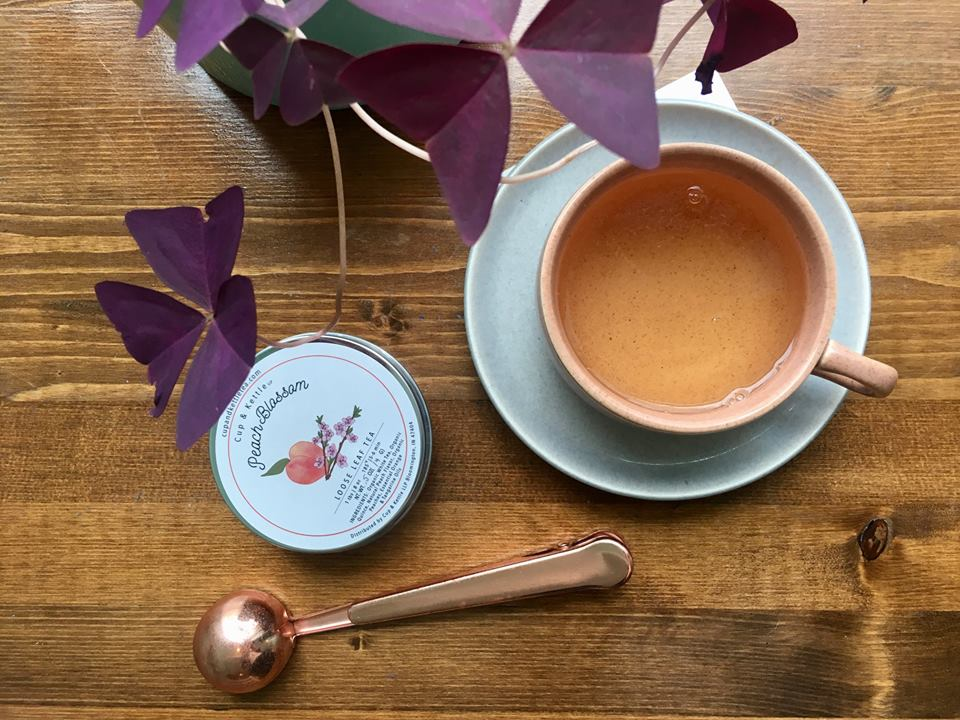

Today on Tea Tuesday we are highlighting Peach Blossom. Peach blossom is our most popular tea for summer. Peach Blossom was one of my very first tea blends, is my husband’s favorite tea for making sun tea. Peach Blossom iced is all at once calming, cooling, and refreshing. I prefer it hot when I can reminisce about summer on a cold winter day.
Peach Blossom tea is blended using our White Peony (Bai Mu Dan) a white tea grown in the Fujian Province of China. Peach Blossom extenuates White Peony’s natural peachy, honey flavor profile. This tea's juicy peach notes are enhanced with hints of quince, vanilla, and zesty tangerine.
To Brew: Use 1-tablespoon tea to 8 ounces of water. Heat water to 185 degrees. Steep for 4 minutes.
For the perfect instant iced tea: Steep 1-tablespoon tea to 4 ounces of water. Heat water to 185 degrees. Steep for 4 minutes. Pour over ice.
For Cold Brew: Use 1-quart glass pitcher, 5 tablespoons of tea leaves, and cold water place in refrigerator over night. The next morning strain out leaves and enjoy!

Monday Muses: Exit West
Today on Monday Muses, I’m talking about a book I just finished called: Exit West by Mohsin Hamid. This book was lovingly brought in to me by a customer at the tea shop. I was excited to read it, but it was a fiction novel.
Today on Monday Muses, I’m talking about a book I just finished called: Exit West by Mohsin Hamid. This book was lovingly brought in to me by a customer at the tea shop. I was excited to read it, but it was a fiction novel. I love fiction, but I have a silly rule that I only read fiction when I’m overwhelmed and stressed. So, it sat for a couple of months untouched. Until, you know, I needed it. Last month, between family illnesses and new challenges at the store, I was ready for an escape. Exit West was the perfect read for how I was feeling.

Spoiler Alert! (If you want to read the book, I would stop reading now)
Exit West begins as a factual novel detailing the life of what it would be like living in a war torn city. The characters, seeking normality, continue taking classes, shopping, scrolling through their phones, trying to forget the chaos that surrounds them. The story depicts the lives of two characters that meet in class and begin to date. We watch the characters relationship evolve as their country falls apart.
As the city begins to fall, we hear rumors of secret doors leading to other places. At first, I thought the characters were so desperate to leave their situation, they were driven to madness and that the doors were imaginary. Then, just as the city is falling the two characters are taken through a door. Again, I found myself intellectualizing that it must be a tunnel underground. The door leads to the Greece. There the characters join a group of refugees. Soon, the camp began running out of supplies so the characters travel through another door, London.
This is where I really fell in love with the book. All over the world doors began becoming enchanted and lead to different places in the world, like random doors, sometimes in people’s homes. This gave people in the story the freedom of escaping bad situations (like civil wars) and made the world almost smaller in a sense. In the sense that we stop feeling that people and places are too far away to impact each other’s lives. In turn, increasing empathy for one another through greater interconnectedness.

Ampersand Woman: Brandi Williams
In a food culture dominated with goods overflowing with sugar, flour, soy, and processed oils, the goal of inspired eats is to supply nutritionally dense, whole food based alternatives. Meet Brandi, the proud owner of Primally Inspired Eats.

Brandi Williams and her husband, Justin, are the proud owners of Primally Inspired Eats. Primally Inspired Eats provides authentic handmade, gluten-free and primal/paleo inspired artisan goods. In a food culture dominated with goods overflowing with sugar, flour, soy, and processed oils, their goal is to supply nutritionally dense, whole food based alternatives. You can find their products at the Bloomington Farmers Market, Bloomingfoods, and Cup & Kettle. Brandi and sat down and talked about what inspires her and how Primally Inspired Eats about. She graciously shared her story with me below.
As I reflected on how to introduce myself I immediately went to the phrase below, “My mother always said….” And my mother always said, “The older you get the faster time goes.” That quote has stuck with me, especially because my mother passed away at the young age of 52. That event certainly shaped the woman I have become today, how I view the world, how I love and view the people I love, and how I choose to spend the time I’ve been granted. In all honestly one of the major driving forces for me is time. Not attempting to beat time, or stop time, but to be present in what I am doing with my time, to consciously choose my own path, and spend the time I have carving out what happiness and success looks like for me. Equally important is to use as much of my time being present with those I love, and exploring the things that interest me the most.
This is where I confess that I am also a self-proclaimed research junky, another driving force. Once curiosity takes hold in me, I will research the heck out of a topic, and make every attempt to immerse myself in it. Nutrition, food, and preventative measures for health and wellness, oh heck yes! Again, the event of having a close loved one experience a health crisis followed by death sent this research junky into overdrive when it came to finding out everything possible in the realm of preventative health and wellness. Which, as you might guess, ultimately led me to cooking and baking with naturally gluten free, grain free, and overall allergy friendly, paleo, keto type ingredients. This took root first within our home, as providing those I love with nutrition and wellness through food, seemed to me, one of the best ways I could love them. Hence, a very fitting way to spend my time.
Besides being a self-proclaimed research junky, I also enjoy sharing the information I gather. Not just sharing but conversing, dissecting, analyzing, debating. All the things I loved so much about grad school. I loved the researching aspect of grad school, but facilitating and teaching in a college classroom was equally influential. I spent two incredibly informative and inspirational years as a graduate assistant for EDCI 285 Multiculturalism and Education. The classroom was filled with undergraduate education majors and we would spend an entire semester unpacking identity in relation to race, class, gender, and sexual orientation, and how this impacted who they would be as teachers, what they brought to the classroom, and how their future student’s individual identities affected what they brought with them into the classroom as well. It was the best in my world. Tough topics, lots of conversation, reflection, research. It had it all. Probably the only other “job,” besides becoming a mother, and creating Primally Inspired Eats, that I have had complete love and passion in doing. Another fitting way, in my mind, to spend some time.
Then came motherhood, which inspired me to knit all these passions together. How I consciously spent my time, which now focuses very much on my kiddos, health and wellness through food and nutrition, and my need and love for research and teaching. The obvious portion of this tapestry has manifested as Primally Inspired Eats. Primally Inspired allows me to share in the best possible way all the things I’ve learned around alternative and nutrient dense focused baking. I get to share the results of that research in the form of really delicious and nourishing baked goods. I also get to have very meaningful, informative, and reflective conversations with our customers, around interesting, and sometimes even tough topics related to health and wellness, another aspect of our business that I completely adore.
Finally, Primally Inspired also allows for freedom. Freedom for me to choose how I spend my time and most significantly, for the daily incorporation of the most important human beings in my life, my children, Ben and Eleanor, and my lifelong love, Justin. We work daily as a family to grow our business, learn from one another in the form of homeschooling, and spend as much time as possible exploring and pursuing our passions. Primally Inspired Eats has gratefully allowed for so many of the things that inspire me to intersect and meet in this particular time and in this particular space. What we would say in our family as “time well spent.” I love it, it’s the best in my world.
I hail from… Greentown, Indiana
I currently live in… Bloomington, Indiana
My morning routine before leaving for work is… Sunday - Wednesday: Coffee, morning snuggles with the kids, Fancy Breakfast, gratitude journalling, and learning work. Thursday - Saturday: Coffee, Baking, and prepping for Market.
My personality at work in three words: Focused, Independent, and Multitasking
My favorite go to tea: Tulsi/Rose
My favorite tea types are… Green, Herbals
My favorite time for tea… Afternoon
When I grew up I wanted to be… A Teacher
When I “grow up” I want to be… Traveler, Explorer
My mother always said… "The older you get, the faster time goes; so value each day."
What I wish I knew when I started working: You can carve your own path. You can be unconventional.
If I could have a power lunch with anyone, living or dead, it would be… Alexandria Ocasio-Cortez
If I could have happy hour with anyone, living or dead, it would be… Maya Angelou

Finish the following sentences:
Success is…. Freedom to create the life I choose
Happiness is… Freedom to create what speaks to me.
Sexy is… Authentically vulnerable
A working woman can never have too many… People in her tribe
Your motto:. "Have an attitude of gratitude"

Ampersand Woman: Amanda Forgas
Today I sat down with the amazing, Amanda Forgas. Forgas is one of the co-owner’s of MIRTH, a curated, edgy women’s apparel store in downtown Bloomington, Indiana. She started working in retail when she was 16…

Today I sat down with the amazing, Amanda Forgas. Forgas is one of the co-owner’s of MIRTH, a curated, edgy women’s apparel store in downtown Bloomington, Indiana. She started working in retail when she was 16. For the past 15 years she has been working for small, local Bloomington businesses. Forgas got her start working for Sole Sensations on Indiana Avenue, Bloomington. She remained at Sole Sensations for 10 years until the owner retired. Forgas then began working for another local, downtown business, Relish. Relish was an iconic contemporary furniture and women’s apparel store that closed in 2017. Working for Relish, Forgas, began to feel confident at the possibility of running her own business. Forgas credits her drive and passion for business to these two business owners.
Here is our conversation:
I hail from… Bloomington, Indiana
I currently live in… Bloomington, Indiana
My morning routine before leaving for work is… wake up, drink warm lemon water, post on instagram, hair and makeup
My personality at work in three words: professional, detail oriented, and likes to have fun
My favorite go to tea: Tension Tamer
My favorite tea types are… Chai, peppermint
My favorite time for tea… all day long
When I grew up I wanted to be… wanted to be an actress
When I “grow up” I want to be… a business owner
My mother always said… “Straighten your shoulders.”
What I wish I knew when I started working: How much there was to learn. When I left Sole Sensations after 10 years, and then going to Relish and starting over; realizing I still had so much to learn.
If I could have a power lunch with anyone, living or dead, it would be… my grandmother
If I could have happy hour with anyone, living or dead, it would be…Jimmy Fallon
Finish the following sentences:
Success is….”happiness”
Happiness is… “found in the little things”
Sexy is… “Confidence”
A working woman can never have too many… “Awesome shoes and porto clothing
Your motto:. “work hard, trust the path, never miss opportunities do the right thing, listen to my inner voice, to excel not compete, and be kind.”

4 Ways to Overcome Imposter Syndrome
I always hear the term: ‘Fake it until you make it’. And I’m thinking ok, sounds easy I guess, but I’m never sure how faking anything will stop making me feel like an imposter. When I was just out of high school, I fell in love with yoga…

I always hear the term: ‘Fake it until you make it’. And I’m thinking ok, sounds easy I guess, but I’m never sure how faking anything will stop making me feel like an imposter. When I was just out of high school, I fell in love with yoga. Becoming a yoga instructor quickly became my life’s dream. I had such an image of what that would look like. I would be in perfect shape, and a complete expert on everything yoga related. I had built it up so much in my head, it took me 5 years to finally earn my yoga teaching certificate.
When it came time to start practice teaching, I was shaking and actually frozen in fear. My first teaching experience, I was assisting a practiced instructor. There was a woman I was trying to help, I was so nervous I was having a hard time helping her into a pose. Finally, she snapped at me and said: “Will you just tell me what you want me to do?!” I of course quietly responded “Nothing you’re doing great” and walked away. I plastered a fake smile through the duration of the class, then after class went to my car and cried. I felt like a total failure.
I had a choice, I could try and conquer my fear, or quit. I had already moved my family across the country, and spent all our savings on this teacher program, quitting just wasn’t an option. I opted to literally fake my confidence, and you know what it worked! I literally pretended like I was a confident, professional yoga instructor. People believed me and treated me like one. After a while, I believed it too and grew to love teaching.
Here are some helpful tips:
Stand up straight
To appear confident, stand and sit tall. To correct your posture, slightly tuck your chin, raise the crown of your head up higher, and roll your shoulders up and back. When I started doing this, I immediately noticed a change in how people approached me. All of a sudden students and teachers alike began talking to me more, and I felt more welcome. Being approachable and comfortable in social situations is a sign that you are confident with who you are. People really notice.
Mimic Good Leaders
See someone doing what you want to do? Pay attention and learn from them. There was a yoga instructor that I really loved her teaching style. I would observe her classes and really watch how she taught. When I first began teaching, I modeled my voice and classes after her. I eventually went on to create my own teaching style, but she was a major influence in its development.
Surround Yourself with Positive People
This is most important. Spending time with people who believe you can do it, eventually convinces you that you really can. Bonus: spending time with positive people who are already doing what you want to do, makes achieving what you want so natural it feels less like a challenge and more like an inevitability.
What to Avoid
Lying about your qualifications. When I first began teaching, I had been studying and practicing yoga for 5 years and had earned my certification at one of the most renowned schools in the country. I really was qualified, I just lacked confidence in my abilities. Embellishing or lying about your qualifications will eventually get you into trouble. It’s much easier to build trust slowly by being honest when you do not have all the answers, rather than giving wrong answers and losing their trust all together.

Tea News: GABA Tea
One examined the effect of GABA on brain waves and the other put the GABA recipients in stressful situations and monitored their immunoglobulin A levels. Together the studies showed that GABA can have a positive impact on reducing anxiety and encouraging relaxation…

What is GABA?
GABA stands for gamma-aminobutyric acid. It is a neurotransmitter, that naturally occurs in the brain. GABA functions to decrease neuron activity assisting in preventing anxiety and stress.
GABA and tea?
Tea manufacturers have started creating GABA tea. This process began in Japan in the 1980s. Dr. Tsushida Tojiro discovered that anaerobic conditions encourage the conversion of glutamate to GABA. GABA occurs naturally in tea, but typically only contains 6 mg per 100 grams of tea. However, GABA tea contains at least 150 mg of GABA per 100 grams of tea. It is interesting to note that the L-theanine that is also present in tea can impact the brain, encouraging the production of more GABA.
What does the research say about GABA?
GABA has been shown to promote sleep, reduce stress, and anxiety.
GABA as a tool to support better sleep has been well documented by researchers. Data about the work of GABA receptors to help with rest have been used to develop a range of sleep-supporting drugs.
Studies have shown where GABA was introduced to humans to examine how it impacts relaxation. One examined the effect of GABA on brain waves and the other put the GABA recipients in stressful situations and monitored their immunoglobulin A levels. Together the studies showed that GABA can have a positive impact on reducing anxiety and encouraging relaxation.
Does “GABA tea” have these effects?
It is not entirely known how much GABA in tea is able to cross the blood brain barrier. However, GABA blood brain permeability has yet to be studied in humans. It is known that in mice GABA is removed 17 times faster than it entered, resulting in conflicting studies of blood brain permeability. Unfortunately, more research is needed.